Tasarım / Yapay Zekâ / Dijital Kültür · Goril Radar’da yayın:
A Digital Portrait of a City: Redrawing Istanbul
Yazar: Ajans Goril / Goril Radar
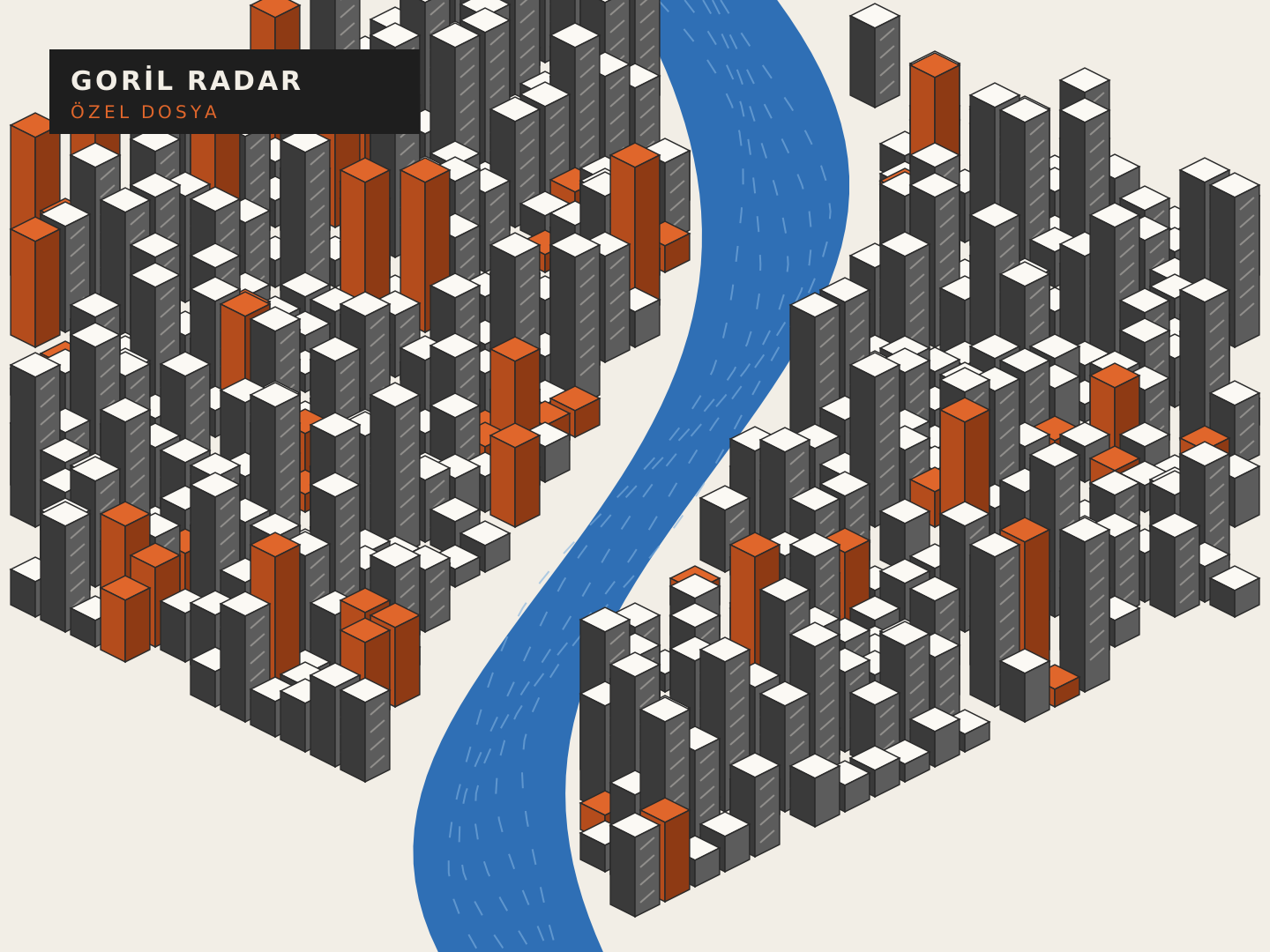
Looking up Istanbul on a map usually means trying to get somewhere on time. Isometric Istanbul, however, extends a different invitation: to forget the route for a while and observe the city's texture. Developed by software engineer Yahya Bedirhan Pak, the project brings together both sides of Istanbul on an in-browser canvas that resembles an intricately drawn scale model.
Reported by Gazete Oksijen and launched free of charge on 28 October, the platform opens up a space for exploration ranging from historic landmarks to neighbourhood backstreets. From Goril Radar's perspective, the intrigue of the project lies not merely in presenting Istanbul differently, but in demonstrating how our relationship with everyday surroundings can shift when urban data, visual design, and artificial intelligence converge.
Haritadan makete, yön bulmaktan bakmaya
Satellite imagery records a city from above. An isometric perspective, by contrast, renders rooftops and facades visible in a single glance, inviting the viewer to read space as an object of design. The scale-model feel of Isometric Istanbul stems directly from this visual language. The city ceases to be a chaotic environment navigated in haste and becomes a composition to dwell upon, examined piece by piece.
Hagia Sophia, the Galata Tower, the Süleymaniye Mosque, or Dolmabahçe Palace might catch the eye at first glance. Yet the true strength of the project lies in where the gaze wanders next. Searching for one's own street, noticing the building density around a local park, or observing the relationship between the coastline and residential settlements from afar offer modest starting points for re-engaging with the city.
Transitioning from the panoramic expanse of Büyükada to the narrow alleyways around Galata demonstrates how seamlessly the experience links different scales. Here, zooming in is not merely a technical function; it is a way to move from the whole to the particular, reading the same city anew from different vantage points.
Görüntünün arkasındaki kent verisi
Beneath this visual realm lies far more than a simple drawing concept. According to Gazete Oksijen, drawing on the project's documentation, the work is fundamentally underpinned by the 3D Istanbul model developed by the Istanbul Metropolitan Municipality's Directorate of Geographic Information Systems.
During the process, two-dimensional captures taken from the urban model at a set angle are transformed into an artistic style using AI models. These small image tiles are then stitched together to create a navigable map. The report states that the land area was divided into 22,042 segments, reaching a total of 24,601 segments when including marine areas.
The same source reports that OpenStreetMap data was used for place names and district boundaries, while Google satellite imagery provided the foundation for maritime regions. These layers serve as a reminder that the cohesive visual universe perceived on screen relies on diverse data and production sources.
Yapay zekâ burada neyi değiştiriyor?
What makes Isometric Istanbul compelling is not artificial intelligence imagining a city from scratch, but its application in transforming the visual expression of an existing urban model. A representational language is layered atop structured data. In this way, a technical model evolves into an exploratory experience that a broader audience can approach with genuine curiosity.
Even so, one should not assume that an illustrated render corresponds identically to physical space. In this article, the map is not treated as a tool for precise surveying or up-to-date structural records. The power of visual interpretation does not equate to the verification of every technical detail.
The constraints of the production workflow are also part of the experience. According to Gazete Oksijen, AI-rendered illustrations for all areas are not yet complete; certain sectors display darkened versions of the source captures instead. Consequently, what lies before us is not a singular, uniformly finished visual product completed in one go.
Bir şehrin kendine özgü dili
The project takes inspiration from initiatives such as isometric.nyc, which focuses on New York, and tiny.london, which renders London in a model-like format. Translating this approach to Istanbul, however, prompts reflections that go beyond a simple change of scenery.
The visual character of a map is defined by the texture of the place it represents. In Istanbul, shorelines, hillsides, dense urban sprawl, and historical layers intersect in a single view. Isometric representation creates a distinct vantage point from which to examine this coexistence through the lens of design. This is not a measured metric of the project, but an editorial reading of the visual experience it delivers.
Goril Radar'ın bakışı: Dijital kültürde yakın çevre
While most digital platforms constantly usher us towards new destinations, Isometric Istanbul provides a reason to look back at a familiar place. Searching for a neighbourhood, panning across the map, zooming in on a fine detail: such simple interactions heighten the prospect of noticing spatial relationships often overlooked in daily life.
The fact that the platform runs in a web browser and is freely accessible lowers the threshold for this exploration. The report notes features such as search, link sharing, and PNG downloads. However, the ability to download an image does not inherently constitute permission for republication or commercial use; the terms set by the project and the respective data providers must be independently observed when utilising these visuals.
Isometric Istanbul reminds us that design is not solely about fabricating new artefacts. Sometimes, design alters how we perceive an environment we thought we already knew. In that sense, redrawing Istanbul is less about giving the city a new face than about paying close attention to it once again.
Kaynak ve proje
This original Goril Radar special feature was rewritten on the basis of reporting by Gazete Oksijen regarding Isometric Istanbul. Details concerning the technical process and platform features are attributed to the original reporting, whilst the assessments reflect Goril Radar's own editorial commentary.
Proje: Isometric Istanbul projesini incele
Kaynakça
- Gazete Oksijen, Isometric Istanbul haberi.
Gazete Oksijen: Isometric Istanbul haberini oku
Goril Radar Özel Dosya · Ajans Goril. Kaynak: Gazete Oksijen. Kaynak bilgileri ile editoryal yorumlar ayrıştırılmıştır.